
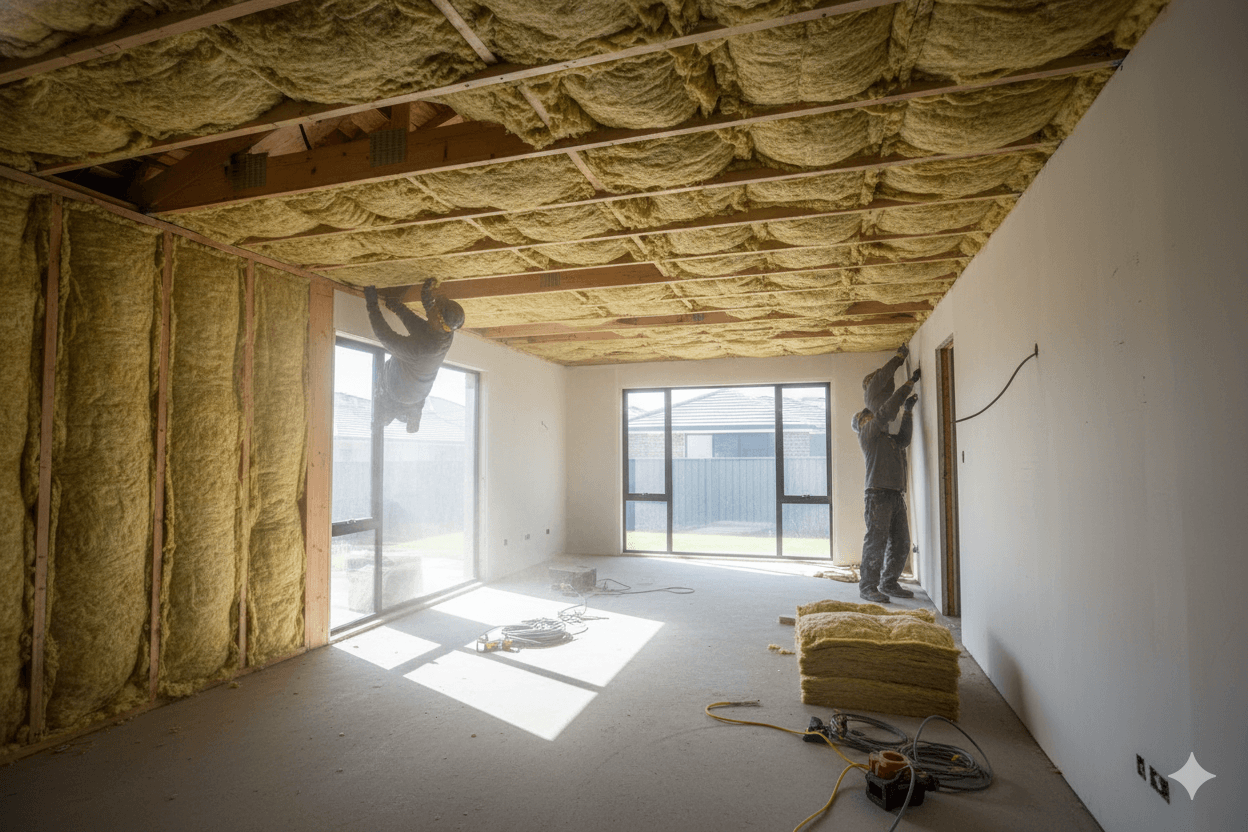
House Insulation Explained: Why It Matters and How It Works
Have you ever walked into a mate’s place on a scorching January afternoon and thought, " Wow, it’s actually cool in here?” Or maybe you’ve noticed how some houses stay perfectly toasty on those bitter, frosty winter nights.
What’s their secret? It’s not magic. It’s a solid thermal barrier.
Proper insulation stops heat dead in its tracks. Because it takes the heavy lifting off your air conditioner and heater, you end up saving a tidy sum over time. So, let’s dig into the nuts and bolts of how this all works, why upgrading is a dead-set brilliant financial move, and how to pick the right materials for your place.
Why It Actually Matters
Let’s be honest. If your roof and walls are bare, you are basically throwing money down the drain every time you flick the heater on. Without a thermal barrier, your heating and cooling systems have to do the hard work just to keep up.
The result? Your power bills go through the roof.
But here is the good news. Fixing a poorly insulated space can chop your energy bills by up to 20%. Depending on the size of your property, you could be looking at an extra $200 to $800 in your pocket every single year. Do the math, and you’ll see that an upgrade usually pays for itself in just three to five years.
It’s not just about the cash, though. We’re talking about finally getting rid of those bizarre hot and cold spots, freezing floors, and dodgy drafts that force you to wear a beanie indoors. Upgrading manages indoor moisture to keep nasty mould at bay and even lowers your property’s carbon footprint.
If your bills are climbing and the air conditioner is running non-stop, it is absolutely time to make your home energy efficient.
The Science of Heat Flow
So, what exactly is happening inside your walls?
It all comes down to a basic rule of thermodynamics: heat naturally wants to move from a warm spot to a cooler one. In July, the warmth from your heater is desperately trying to escape outside. Come summer, the blazing heat outdoors is trying to push its way into your lounge room.
Insulation puts the brakes on this through three different avenues:
- Conduction: This is heat moving directly through solid stuff, like your walls. Insulation creates tiny pockets of trapped air to interrupt this flow.
- Convection: Heat circulating through the air. Insulation tackles this by restricting airflow within enclosed spaces.
- Radiation: Heat moves through space as radiation. Bounced back by shiny materials - think foil or special barriers meant to reflect it. Infrared energy gets redirected before soaking into the surroundings.
You will inevitably hear tradies talking about 'R-values'. Put simply, this is the rating of how well a material resists conductive heat flow. A higher number means better protection. If you are looking into House Insulation in Melbourne, the specific R-value you need depends entirely on the local climate zone and the part of the property you are upgrading.
Picking Your Materials
Not all materials are created equal.
Fibreglass (or glass wool) is the classic choice. It’s cheap, fire-resistant, and comes in batts or loose-fill. The catch? It doesn't block air leaks on its own.
Then you have Cellulose. Recycled paper, once old newspapers, forms most of this material after being soaked in flame-resistant chemicals. Its tight structure slows down air movement very well - ideal when upgrading buildings that were built long ago.
Spray foam is a whole different beast. It goes on as a liquid and blows up into a solid, creating a completely airtight seal. It boasts a massive R-value and handles moisture brilliantly. The downside is the price tag; it costs more upfront, and you absolutely need a pro to install it.
Finally, Rigid foam boards (like XPS or polyiso). These pack a high R-value per inch and are usually applied across the entire building envelope to stop heat from leaking through timber wall studs.
Busting the Myths
Let’s clear up some nonsense.
Myth one: Insulation is unnecessary in warm countries. Don't think so! It acts as a barrier, blocking out the sizzling sunshine in summer and easing up the burden on your air conditioning units. It's reasons like these which make home insulation in Melbourne so important for a sizzling 40C day as well as a nippy winter.
Myth two: Too much is never enough. Not so. The more insulation you layer into your home, the higher the R-value, the more thermal protection you have. But once you go over your recommended R-value, the more you add will do nothing to save you any more money.
Myth three: Squashing it flat makes it function more effectively. Absolutely not! Fibreglass, for instance, relies upon those microscopic air bubbles acting as insulation. If they are compressed and squished out, you have totally underperformed.
Wrapping It Up:
At the end of the day, if you wrap your house properly, that is an intelligent financial decision to have long-term benefits. It minimises your monthly expenditure, increases your house's worth and makes your home more comfortable.
However, before you dash out to buy all the products, ask your pro to come and do an energy audit or thermal imaging scan. This eliminates the surprises to make sure you know exactly where you're losing energy and, therefore, which solution is the perfect one.








0 Comments